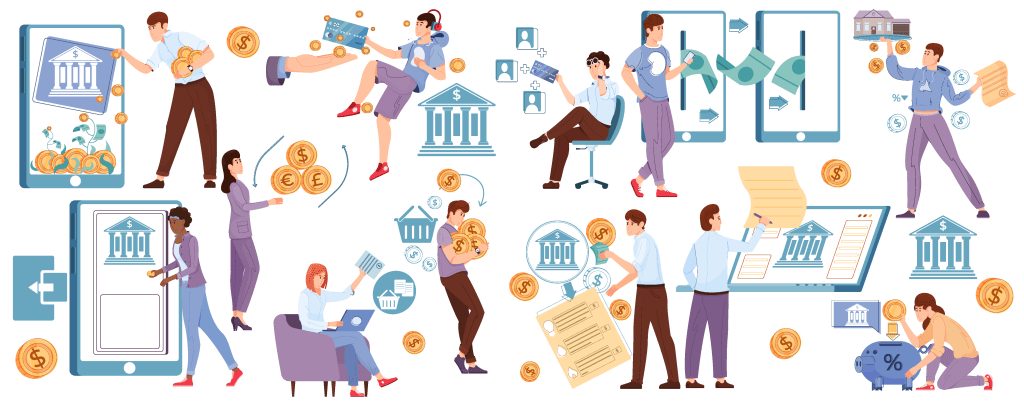
How money circulates and the importance of Citizens
In the distant past before there was any official money, there was a small community of 4 families that lived and worked on farms. Each farm was managed only to support each family. On Sunday the families got together to talk about work, life and the universe.
During one of these discussions they got to thinking about how it was not very efficient having 4 farms that produced the same things. It was risky eg if certain crops failed then they failed for everyone so they decided that it would be good if they farmed different crops and livestock on different farms. A great leap forward but they soon learnt that they needed a method of dividing the produce of each farm.
One of the youngsters who had this modern calculator called an abacus said “We need a medium of exchange and using my abacus to record who owns what we should create currency that I call abacoin”. So the families allotted 1000 abacoin to each family with a restriction on how many abacoin could be issued in the future. The families guaranteed that 1 abacoin was worth 1 abacoin and that they would only trade with each other in abacoin.
The families then proceeded to trade and buy each family’s goods they produced and were surplus to the producers needs with abacoin.
Very quickly it became clear that as different crops and products were produced at different times the flow of abacoins changed direction and concentration constantly and fairly with all 4 families having a better lifestyle through having available differing food products all year round and a lower risk of produce failures. Constantly circulating the abacoins increased everyone’s lifestyle and wealth. Especially the youngster with the abacus who charged a small fee for record keeping and managing each transaction.
As time went by it became obvious that one family had gained a very large advantage over the others. This family had access to a more reliable water supply because they discovered a hidden spring that flowed water whatever the conditions. This lucky family were able to produce more from less effort and so were able to sell more and accumulate abacoins from the other families.
As our lucky family did not need to buy extra produce above what they required they accumulated abacoins and the other families pile of abacoins decreased. This was a terrible outcome as the lucky family kept prices their high and the unlucky families prices low. Consequently, the unlucky families pile of abacoins continued to decrease as did their lifestyle and wealth because our lucky family controlled a finite resource and did not continually circulate its abacoins. This result divided the community into a have and have nots.
So what happened next? A problem for the community to solve
All money is held in Megabank as described under the previous topics. Leaving aside Australia’s account with the rest of the world for now, Australian Money is a closed system where all transactions between parties must balance, and Money stays in the Australian banking system. The balance is only changed by the creation and destruction of Money, described in previous topics, by Megabank lending and governments borrowing.
Simply, if a citizen uses Money to purchase goods, services or assets the Money stays in the system and remains on deposit under a different depositor name. In a perfect world, the new depositor would then spend that money on different goods and services and the cycle continues, creating beneficial economic activity. As an example, if a citizen buys a good from a business that uses those funds to pay for the raw materials, labour, manufacture, and research & development then this generates productive economic activity without increasing the Money balance but increasing the Money value.
The speed of circulation of money in the system adds greatly to economic activity to the benefit of all, even as the Money balance does not change but the value of Money does.
Money can also be used to pay for goods, services and assets where it is transferred to parties that don’t continue the cycle of Money circulation through economic activity. This happens in two types of circumstances. Firstly, where an economy has a high concentration of the suppliers of goods and services, enabling rent seeking and a lack of competition, and a concentration of the owners of those suppliers. Secondly, where Money is used to buy an asset as a store of value (eg gold, houses and many others) and the seller continues the cycle of buying stores of value rather than goods and services. In both these situations the speed of circulation of Money is slowed or stopped, and this strangles economic activity. Sound familiar?
With these simple explanations of money circulation, Rule 4:
Rule 4: The majority of citizens, small business or businesses in competitive sectors that sell goods and services for Money that continually circulates are critically important and highly beneficial to sustainable economic activity and the value of Money. Whilst those citizens and businesses that slow down Money circulation by speculating on assets are detrimental to economic activity.
Now we exponentially increase the Money circulation with Money creation through debt. As we described previously, citizens create Money by borrowing from Megabank that then creates the balancing Money deposit. This process adds to the Money balance and at the same time the rule on Money circulation applies. But the difference from our Money circulation description is that the addition of the loan used to create Money must be repaid. The Money to repay the loan exists as deposits on Megabank’s balance sheet in any number of bank accounts. By the process of the borrower selling its services or goods for Money, he or she can repay the loan which reduces the Money balance. Megabank lends the Money based on the probability of receipt of Money by the borrower from selling goods and services.
However, where the circulation of Money is hindered by a concentration of businesses and citizens that slow down money circulation as previously described, then the ability for the borrower to earn Money to repay the loan is diminished. In these circumstances the only way the loan can be repaid is to create more Money and new larger loans, in an ever-increasing loan cycle. The only way that Megabank would continue to lend under these circumstances is if the assets used to support the loans continue to increase in value, or at the very least not decrease in value. By increasing the Money balance through lending then there is always sufficient Money for borrowers to repay loans either by earning or selling.
The problem with this process is that all uncontrolled positive feedback loops have a limit and will eventually break, as they need to run faster and faster to deliver more and more Money. More citizens must be drawn into the borrowing process and loan balances must get larger and larger until some citizens are left holding the parcel because they have no ability to earn the Money required to repay the loans. In the real world this process is a continual cycle of creating too much Money followed by loan losses and asset value decreases, a process that has been occurring for millennia. However, the build-up to the end of cycle can last a long time as it’s perpetuated by Megabank, the government and other vested interests. While this cycle is not unusual it’s also not something that should be allowed to occur in a way that threatens the stability of the Money system, as defaulting loans destroy Money and have significant negative consequences. Adding debt arcs up the risk, Rule 5 is:
Rule 5: Debt that creates Money is not necessarily a bad thing in circumstances where the repayment of the loan is based on earning Money from positive economic activity. If it is not productive debt and is based on rising asset prices, a positive feedback loop of ever-increasing Money creation is triggered that can have drastic negative consequences for the Money balance and its value when the cycle eventually ends.
 Money for the Masses, ECONOMICS FOR EVERYONE